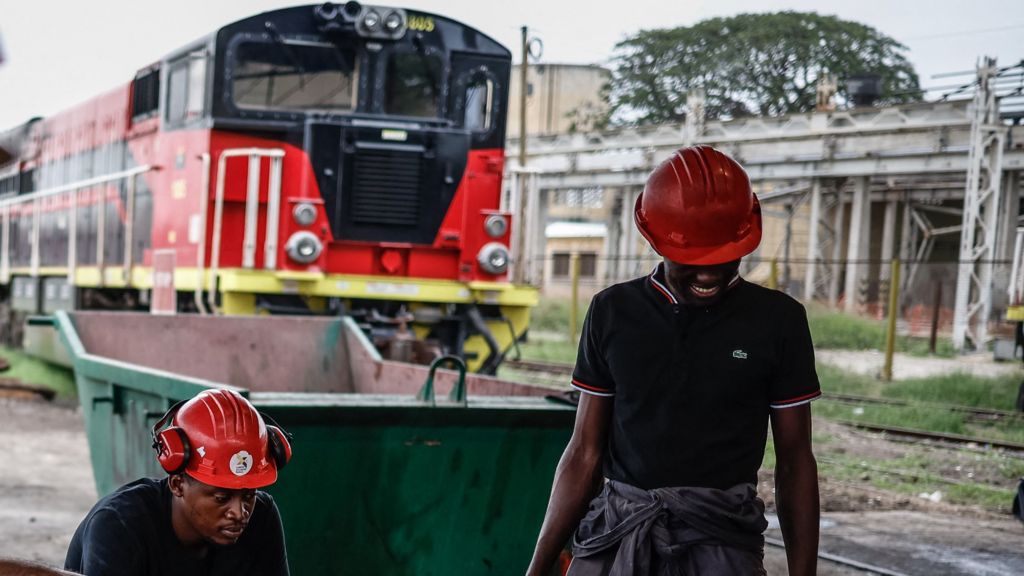
A railway project, known as the Lobito Corridor, is at the heart of an initiative backed by the United States to secure access to Africa's critical minerals. The corridor, which runs through Angola's Atlantic coast and passes through the DR Congo town of Catumbela, has improved local transportation for residents like 20-year-old Manuela Julia. However, its larger objective is to promote regional economic cooperation, curb illicit mineral trade, and potentially bring peace to conflict-prone eastern DR Congo. The project involves greater economic cooperation between the DR Congo and Rwanda, including more transparent mineral supply chains and regional infrastructure development. The wider plan envisions linking these initiatives to the railway, which transports minerals from Central Africa to Western markets via Angola, rather than east to China as most currently do. Copper and cobalt, critical for clean energy components, are driving the demand for this route. The US sees the corridor as a means to diversify mineral supplies and reduce reliance on China. The project has attracted over $750 million in funding, including support from the US International Development Finance Corporation and the Development Bank of Southern Africa. The railway was built in 1902 under Portuguese colonial rule and reopened in 2015 after years of disruption during Angola's civil war. The corridor has the potential to offer mining companies a shorter route to international markets, but it remains to be seen if it will lead to economic transformation for the region.
The Lobito Corridor, a railway project connecting the mineral-rich south of the Democratic Republic of Congo (DR Congo) to Angola's Atlantic coast, is part of a US-backed initiative aimed at securing access to Africa's critical minerals and promoting regional economic cooperation. The corridor has improved local transportation for residents like 20-year-old Manuela Julia in Catumbela, but its larger objective is to help bring peace to conflict-prone eastern DR Congo by curbing illicit mineral trade. Under agreements brokered by US President Donald Trump, the DR Congo and Rwanda have committed to greater economic cooperation, including more transparent mineral supply chains and regional infrastructure development. The wider plan envisions linking these initiatives to the railway, which transports minerals from Central Africa to Western markets via Angola, rather than east to China as most currently do. Copper and cobalt, critical for clean energy components, are driving the demand for this route. The US sees the corridor as a means to diversify mineral supplies and reduce reliance on China.
The Lobito Corridor, a railway project connecting the mineral-rich south of the Democratic Republic of Congo (DR Congo) to Angola's Atlantic coast, offers mining companies a shorter route to international markets. The corridor has already attracted over $750 million in funding and is expected to transport about 200,000 tonnes of copper through the corridor in 2026. Zambia, Africa's second-largest copper producer, also plans to connect its Copperbelt to Lobito through a proposed railway. However, while a more efficient route to market is beneficial for mining companies, it remains to be seen if it will lead to economic transformation for the region. Political risk analyst Wellington Muzengeza cautions that "joining a corridor is not the same as industrialising." The test is whether the route helps build a stronger economy. Some Angolans believe the railway's greatest value could lie in what it offers businesses and communities beyond mining, such as better transport links for farmers to reach larger markets and reduce losses.