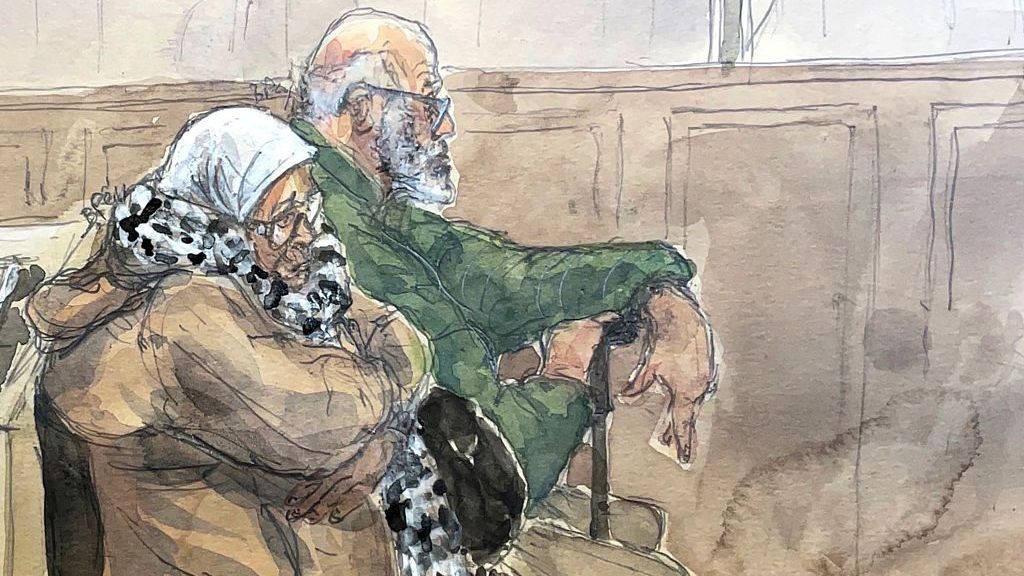
A French court has convicted Halima El Bakhti, 72, and her husband Ahmed Touloub, 74, of torturing their four-year-old daughter Inass Touloub to death in central France in 1987. El Bakhti was sentenced to 20 years in prison for "torture and acts of barbarity resulting in death without the intent to kill", while her husband received a 15-year sentence as an accomplice. The girl's body was found along the A10 motorway near Suèvres, Loir-et-Cher department, with multiple signs of abuse including human bite marks, broken bones, and burns inflicted with an iron. For three decades, Inass was known only as the "Little Martyr of the A10" until her identification in 2018 through DNA matching with her brother's test results from an unrelated case. The trial took place at Loir-et-Cher Assize Court from November 2nd, and the verdict was delivered on Tuesday after several hours of deliberation. Prosecutor Anaïs Allio described the child's condition as "unbearable" during the autopsy, with not a single part of Inass's body spared from abuse. The jury considered El Bakhti's impaired judgement at the time of the girl's death, which reduced her potential sentence. The defendants have 10 days to appeal the verdict. This case led one of France's biggest ever investigations with the girl's photograph posted in public places and an alert sent to more than 30 countries.
In a shocking verdict, Halima El Bakhti, 72, and her husband Ahmed Touloub, 74, were found guilty of torturing their four-year-old daughter Inass Touloub to death in France in 1987. El Bakhti was sentenced to 20 years in prison for "torture and acts of barbarity resulting in death without the intent to kill", while her husband received a 15-year sentence as an accomplice. The little girl's body was discovered along the A10 motorway near Suèvres, Loir-et-Cher department, bearing multiple signs of abuse including human bite marks, broken bones, and burns inflicted with an iron. For almost three decades, Inass was known only as the "Little Martyr of the A10" until her identification in 2018 through DNA matching with her brother's test results from an unrelated case. The trial took place at Loir-et-Cher Assize Court from November 2nd, and the verdict was delivered on Tuesday after several hours of deliberation. Prosecutor Anaïs Allio described the child's condition as "unbearable" during the autopsy, with not a single part of Inass's body spared from abuse. The defendants have 10 days to appeal the verdict. This case led one of France's biggest ever investigations with the girl's photograph posted in public places and an alert sent to more than 30 countries.
In a long-awaited verdict, Halima El Bakhti, 72, and her husband Ahmed Touloub, 74, were convicted of torturing their four-year-old daughter Inass Touloub to death in central France in 1987. The trial took place at Loir-et-Cher Assize Court from November 2nd, with the verdict delivered on Tuesday after several hours of deliberation. El Bakhti was sentenced to 20 years in prison for "torture and acts of barbarity resulting in death without the intent to kill", while her husband received a 15-year sentence as an accomplice. Inass's body was found along the A10 motorway near Suèvres, Loir-et-Cher department, three decades ago. She was buried in an unmarked grave near the location where her body was found, known only as the "Little Martyr of the A10". In 2018, she was identified through DNA matching with her brother's test results from an unrelated case, leading to their arrest. During the trial, prosecutor Anaïs Allio emphasised that "not a single part of Inass's body was spared", and recalled the "sense of vertigo that overcame us all" upon viewing the "unbearable photographs" from the autopsy. The defendants have 10 days to appeal the verdict. This case sparked one of France's biggest ever investigations, with the girl's photograph posted in public places and an alert sent to more than 30 countries.