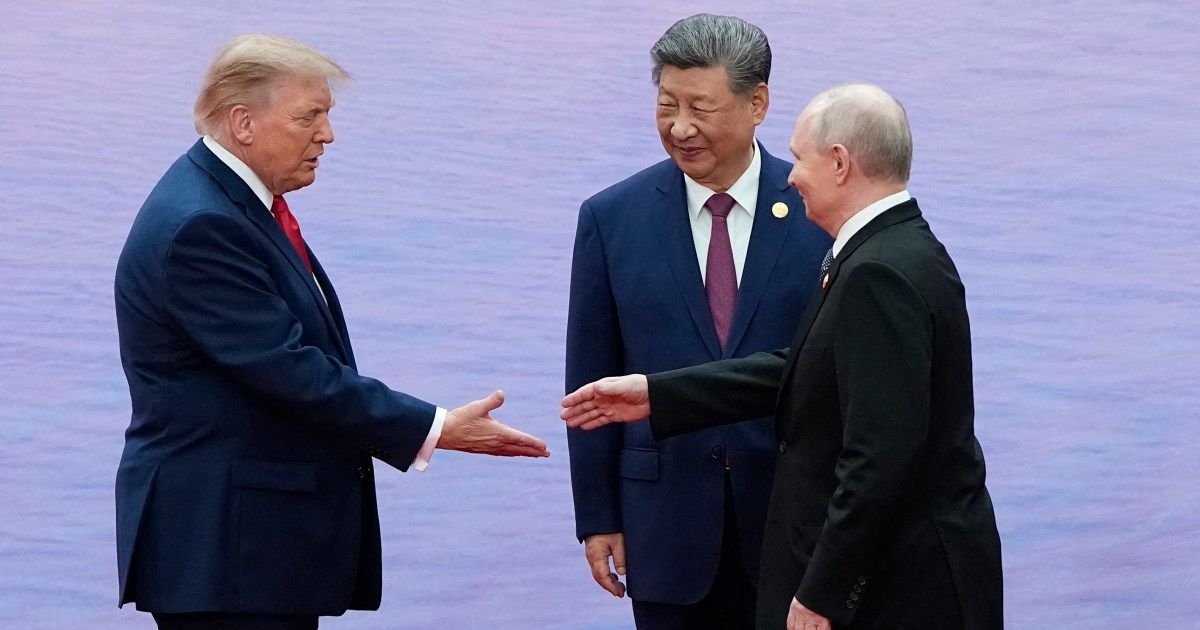
Leaders from the United States, China, and Russia are set to convene for their first three-way meeting on Thursday in Shenzhen, a historic event that has been compared to the 1945 Yalta conference. The meeting, which will take place during the Asia-Pacific Economic Cooperation (APEC) summit, brings together the heads of the world's most powerful militaries. However, unlike at Yalta where the allies had agreed on a post-war order, analysts suggest that the three leaders have different agendas for this meeting, and few concrete outcomes are expected. President Trump plans to discuss the ongoing war with Iran and a potential trilateral agreement on nuclear armament, while Ukraine is not anticipated to be on the formal agenda due to Xi's reluctance to involve himself in what he views as a European matter. Tensions have been running high between the US and its traditional allies, with Trump considering troop withdrawals from South Korea and cuts to aid for Japan, while simultaneously describing China as Washington's main geopolitical rival. Vuk Vuksanovic, a lecturer in foreign policy and grand strategy, emphasizes that this summit should not be viewed as a new "carve-up" of the world order, but rather as a discussion among leaders with competing interests.
As Trump arrived in Shenzhen on Wednesday, Xi greeted him at the airport, marking their third in-person meeting since they temporarily suspended their bitter trade war late last year. At its peak, US tariffs on Chinese goods reached 145 percent, with China retaliating with tariffs of 125 percent on American goods before a temporary truce agreed in Busan, South Korea, in October 2025. Xi also agreed to pause new restrictions on exports of some rare earth metals essential for manufacturing technology, leading to the relaxation of some US restrictions on the sale of Nvidia AI-related computer chips to China. Friction remains, with China's rare earth mineral exports to the US still approximately 75 percent below normal levels and a scandal over Megaspeed, a Singapore-based data center company accused of diverting Nvidia chips to China in violation of US export controls, further straining relations.
Ahead of this meeting, Trump's special envoys, Steve Witkoff and Jared Kushner, have been involved in talks between Russia and Ukraine in Abu Dhabi on November 10 and 11, marking the first direct format discussions since February. The pair has visited both Kyiv and Moscow to promote these talks in recent days. However, expectations for a significant breakthrough are low, with Deborah Elms, head of trade policy at the Hinrich Foundation, suggesting that a handshake without incident would be seen as a positive outcome. Amidst this gathering, tensions between Trump and Ukrainian President Volodymyr Zelenskyy have escalated, with Trump publicly admonishing Zelenskyy for targeting Russian energy facilities and driving up global oil and diesel prices.
In the lead-up to their meeting, Trump has claimed that Washington and Moscow are close to a "big, beautiful agreement" covering not just Ukraine but all of Europe, signaling a softening in his rhetoric towards Putin compared to his hardline stance against Zelenskyy. It remains to be seen how this trilateral meeting will shape the geopolitical landscape and whether any significant agreements or understandings will emerge from this historic gathering.