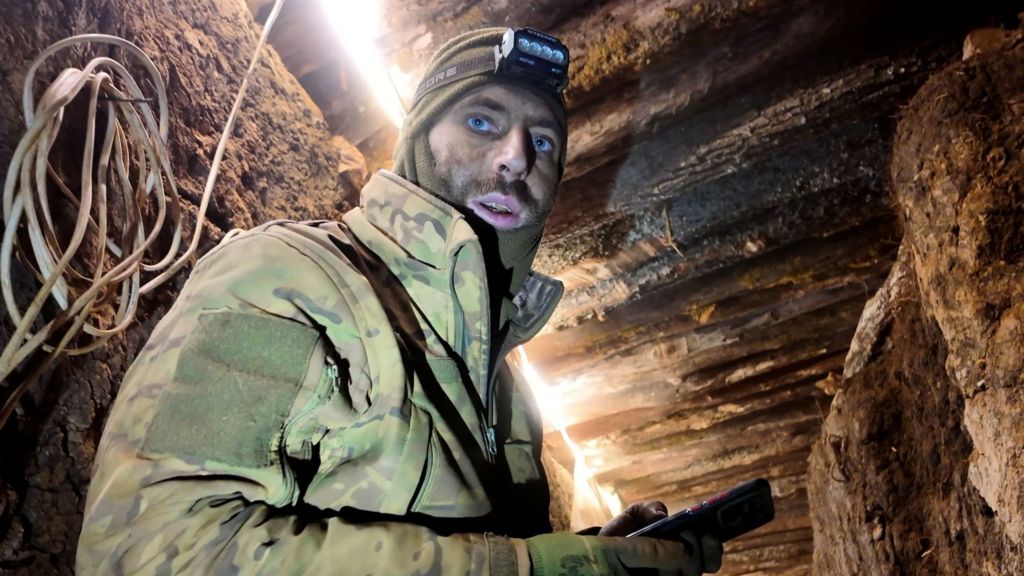
In the ongoing conflict between Ukraine and Russia, a new front has emerged, this time under the ground in the Kharkiv region. For the past seven months, Ukrainian forces have been fighting Russian troops within an old Soviet gas pipeline, due to the increasing use of drones above the front line. With only enough room to crawl, this subterranean battleground offers relative safety from aerial surveillance and makes it challenging for either side to advance. The journey to reach this underground battlefield is fraught with danger, involving a high-speed vehicle ride across open fields and a long march through muddy terrain. Both sides have exploited the pipeline to access the surface, where most of the fighting takes place. Since September 2025, the Russians have used the pipe to infiltrate Kupyansk, but Ukrainian forces have managed to gain the upper hand, with a specially designed electric cart transporting troops and supplies through the pipeline. The cart occasionally breaks down, making the journey difficult, and there has been fighting within the pipeline as well. Operation Veles, named after a mythical Slavic god of the underworld, was initiated in April, resulting in Ukraine advancing 15km (9.3 miles) along the pipeline over painstaking, backbreaking work. Hundreds of Colombian volunteers from the RUG 23rd Assault Regiment have also been involved in this operation, helping to boost Ukraine's depleted ranks.
SUMMARY (CONTINUED): The subterranean battlefield is a harsh environment, with soldiers spending much of their time on their knees and suffering abrasions. The confined space has caused some soldiers to experience panic attacks, while others have struggled to breathe. A commander with a former life as a miner helps the troops cope with the physical and psychological challenges of operating underground. From a building on the surface, he keeps in regular contact with his men still in the pipeline and maintains a cabinet full of medicine for their needs. The Colombian volunteers, one of whom goes by the call sign Gecko, have faced difficulties clearing the detritus, water, and Russian barricades within the pipeline. They encountered booby-trapped barriers and piles of Russian bodies, adding to the danger of operating in such a confined space. The soldiers report that there has been heavy fighting above ground as well, with Ukraine claiming to have killed more than 100 Russian soldiers and taken 30 prisoners during Operation Veles.
SUMMARY (CONTINUED): The underground battlefield is a testament to the resilience of Ukrainian forces in the face of adversity. Despite the challenges, they have managed to gain ground against Russian forces, using innovative methods like the Kupyansk metro to transport troops and supplies through the pipeline. However, the danger remains high, with soldiers constantly at risk of coming into contact with the enemy or being injured by ricochets from gunfire. The use of underground pipelines as a battleground is not new, but Ukraine's successful defense against Russian infiltration has set a precedent for future conflicts. As the war continues to evolve, it remains to be seen how both sides will adapt to this subterranean front line and what new tactics they will employ to gain an advantage.