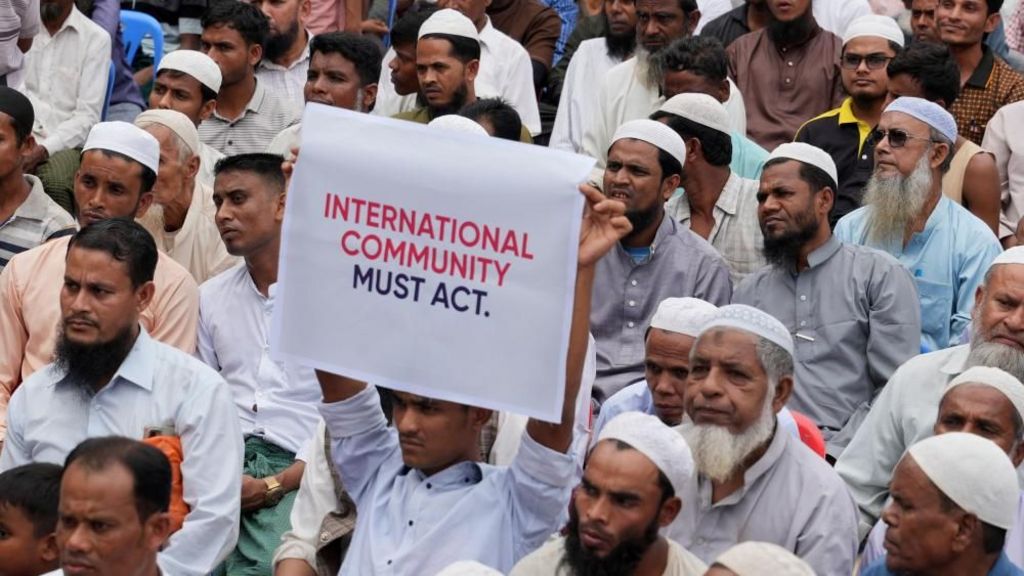
In an unprecedented ruling, the International Court of Justice (ICJ) has found Myanmar guilty of committing genocide against its Rohingya minority. This is the first time a state has ever been found to have committed genocide by an international court. The decision, reached by a majority vote of nine judges out of 15, was made in response to a case brought by The Gambia that centered around "clearance operations" initiated by Myanmar's military in 2017 in Rakhine State, where many Rohingya Muslims resided. The court found that the Myanmar military had engaged in indiscriminate killings, widespread sexual violence, extreme violence against children, and the deliberate burning of Rohingya homes. The ICJ determined that around 10,000 Rohingya were "violently killed" during the clearance operation, while more than 700,000 are thought to have fled to Bangladesh by foot or by sea. The court also found that policies like limiting married couples to two children, aimed at eroding Rohingya rights, were discriminatory. Myanmar's military was accused of engaging in "extensive destruction of evidence" and attacking Rohingya as they were fleeing to Bangladesh. The ICJ acknowledged the role played by Arakan Rohingya Salvation Army (Arsa) but found that an anti-Rohingya hate speech campaign, which portrayed the Rohingya as "sub-human" and "a violent threat," overlapped with the clearance operations, making violence against the population more likely.
SUMMARY (CONTINUED):
The ICJ's decision was welcomed by Rohingya communities and human rights groups. Mohammed Nowkim, a Rohingya who was driven out of Rakhine in 2017 and now lives in Canada, said the ruling was "like formal recognition of our suffering." Human Rights Watch described it as "long-awaited recognition of the suffering the Rohingya have endured." UN human rights chief Volker Türk called the court's decision "a stain on the conscience of humanity" and urged real action to be taken. The ICJ also found that Myanmar had violated several other parts of the 1948 Genocide Convention, but an exact figure for reparations has not yet been determined. The ruling is without precedent, as this is the first time a state has ever been found guilty of genocide by an international court.
SUMMARY (CONTINUED):
Myanmar's government consistently denied genocide against the Rohingya, claiming its operations were targeted at militant or insurgent threats in response to attacks by Arsa. In January, a government representative told the ICJ that Myanmar "was not obliged to remain idle and allow terrorists to have free reign." The ICJ's ruling is significant as it sets a precedent for holding states accountable for genocide, a crime under international law that carries a high evidential bar. Dozens of individuals have been found guilty of genocide, but finding their actions were at the direct behest of the state requires even more evidence. The ICJ has only twice before ruled on claims of state-backed genocide since the Genocide Convention was signed in the aftermath of the Holocaust, finding insufficient evidence to attribute the actions to the state in both cases.