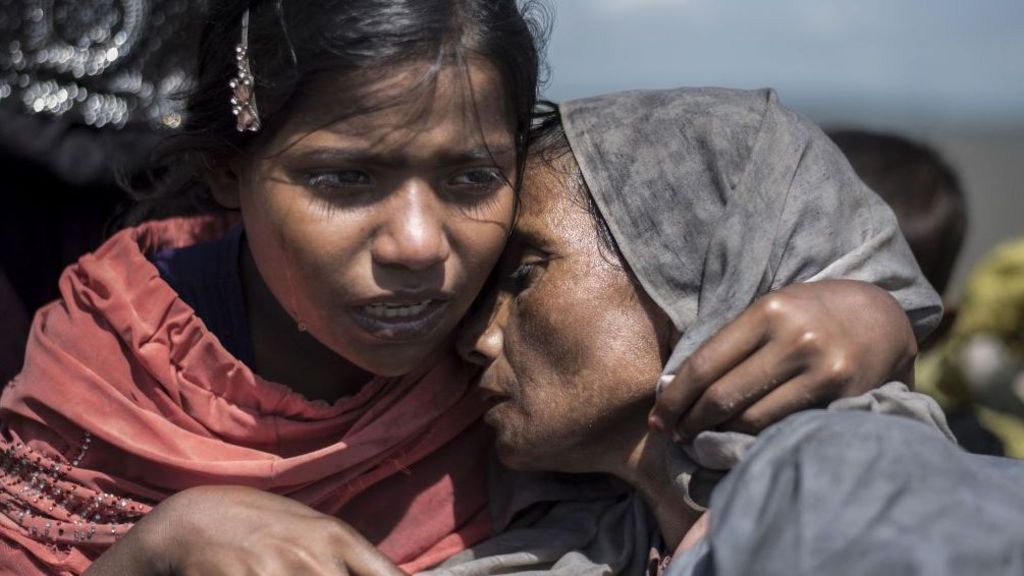
In a groundbreaking international court case, the International Court of Justice (ICJ) is poised to deliver a historic verdict against Myanmar for allegedly committing genocide against the Rohingya population. If found guilty, it would be the first time a state has been held responsible for this crime under international law. The case was brought forward by The Gambia in 2019, accusing Myanmar of violating the Genocide Convention due to its alleged ethnic cleansing and massacres of Rohingya Muslims in Rakhine State in 2017. Myanmar authorities have denied these allegations, claiming they were only responding to terrorist actions by Rohingya militants. The ICJ was chosen as the venue for this trial due to the lack of other avenues for redress for the victims. Aung San Suu Kyi, the Nobel laureate who led Myanmar's initial legal defense at The Hague, faced widespread criticism for her defense of the military's actions. Historically, proving genocide has been challenging due to the high bar set by judges, but the evidence presented against Myanmar may be sufficient to meet that standard, according to Arsalan Suleman, the lawyer leading the case against Myanmar at the court.
In the years since the Genocide Convention was signed in 1948, following the Nazi Holocaust, dozens of individuals have been successfully prosecuted for genocide, but no state has ever been found guilty by an international court of committing genocide. The mass expulsion of the Rohingya population from Rakhine State in August and September 2017 was a military operation of exceptional brutality, according to reports and documented accounts of killing, torture, and mass rape by Burmese soldiers. Human rights groups and a United Nations fact-finding mission have thoroughly documented these accounts, as well as the systematic obliteration of Rohingya villages by the Myanmar state.
The International Court of Justice was established in 1945 to help settle disputes between states, not to try international crimes. However, it was chosen to address the attacks on Rohingyas in Myanmar because there were few other avenues of redress for the victims. Myanmar authorities have denied accusations of ethnic cleansing or genocide, saying they were only responding to terrorist actions by Rohingya militants with so-called military "clearance operations". A UN report in 2018 said the army's tactics were "grossly disproportionate to actual security threats". It also accused top military figures in Myanmar of genocide and crimes against humanity. Myanmar rejected the report.
The case has drawn attention due to Aung San Suu Kyi's personal involvement, who faced widespread criticism for her defense of the military's actions. Since she was deposed by a coup in 2021 and placed under arrest, the defense has been led by a new team appointed by the military. Proving genocide has been historically challenging due to the high bar set by judges. Typically, where there is no explicitly genocidal program, like that of the Nazis, the judges require that the evidence presented at court must be such that the only reasonable inference from the actions of the defendants is that they had genocidal intent. The weight of evidence presented against Myanmar by Arsalan Suleman and his team may be sufficient to meet this high bar.