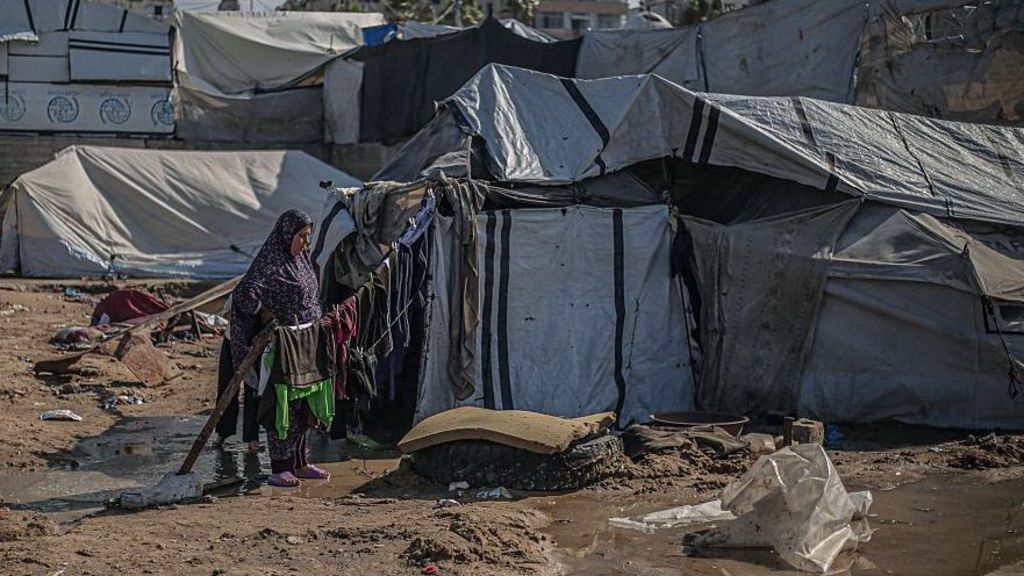
The US President Donald Trump-backed Board of Peace has urged Israel to immediately allow necessary humanitarian supplies into Gaza following heavy rains that flooded tens of thousands of tents. The board, established to oversee the implementation of Trump's Gaza peace plan, stated that while they acknowledge the steps being taken by Israel, the response is deemed insufficient. Israel's military agency responsible for coordinating aid into Gaza has allowed in tens of thousands of tents and trucks with winter supplies, but reconstruction can only begin after Hamas disarms. On Sunday, four civilians, including three children, were killed when a sand embankment collapsed onto tents in the central Strip. The United Nations reports that around 1.4 million people, or about 65% of Gaza's population, now live in tents or makeshift shelters due to military actions by Israel. In response to the flooding, the Board of Peace has called on Israel to authorize the entry of essential goods for temporary shelter and water and sanitation infrastructure. The board claims that delays in approving the entry of supplies have exacerbated the consequences of a foreseeable humanitarian challenge and delayed the start of decommissioning weapons and transferring Hamas authority to a transitional government. The UN's humanitarian agency OCHA reports that more than 150,000 tents are ready for distribution but aid efforts are constrained by Israeli restrictions on the entry of supplies and equipment and funding shortfalls. The UN humanitarian coordinator has called for Israel to immediately lift all restrictions on the entry of supplies. Israel's foreign ministry spokeswoman has stated that Israel has implemented a winter plan in coordination with the Board of Peace and international charities, bringing in over 91,000 tents and 8,200 trucks with relief supplies. However, Israel has refused to allow in equipment that could be used for military purposes. The Israeli foreign ministry spokeswoman accused Hamas of hoarding aid, stating that the group is responsible for delays in making more progress in Gaza. In response, Hamas denied responsibility for the disaster and accused Israel of violations, pointing to a statement by Egyptian, Qatari, and Turkish mediators from August. The group also stated that Israeli restrictions prevent the entry of materials necessary for shelter and recovery and accused the Board of Peace, as the ceasefire implementor, of having serious shortcomings. The peace plan, which aims to end the two-year war in Gaza, has been stalled due to a dispute over Hamas's disarmament before Israeli troop withdrawal.
The US President Donald Trump-established Board of Peace has expressed concern over the insufficient humanitarian aid response by Israel following heavy rains and flooding in the Gaza Strip. The US-backed body, tasked with overseeing the implementation of Trump's Gaza peace plan, has criticized the Israeli government for delaying the entry of essential goods such as tents, water, and sanitation infrastructure. According to reports, heavy rains have caused flooding in tens of thousands of tents, displacing a significant portion of Gaza's population who already live in precarious conditions due to military actions by Israel. The Board has called on Israel to immediately authorize the entry of these critical supplies and has accused delays in approving their entry as exacerbating the consequences of a foreseeable humanitarian challenge. Israel's military agency responsible for coordinating aid into Gaza has allowed in tens of thousands of tents and trucks with winter supplies, but reconstruction can only begin after Hamas fully disarms. The UN reports that more than 1.4 million people, or about 65% of Gaza's population, now live in tents or makeshift shelters due to military actions by Israel. The Board of Peace has also criticized Hamas for failing to disarm and transfer power, which it claims has compounded the difficulties facing Gaza's civilians.
The US President Donald Trump-backed Board of Peace has criticized Israel over its response to the flooding in Gaza, which has left tens of thousands of people displaced and living in makeshift shelters. The board, established to oversee the implementation of Trump's Gaza peace plan, has stated that while Israel is considering steps to address the crisis, its response remains insufficient. The Israeli military agency responsible for coordinating aid into Gaza has allowed in tens of thousands of tents and trucks with winter supplies, but reconstruction can only begin after Hamas disarms. On Sunday, three children and a woman were killed when a sand embankment collapsed onto tents in the central Strip. Most people in Gaza have been displaced due to Israel's military actions, with around 65% of the population, about 1.4 million people, now living in tents or makeshift shelters according to the UN. In response to the flooding, the Board of Peace has called on Israel to authorize the entry of essential goods for temporary shelter and water and sanitation infrastructure. The board claims that delays in approving the entry of supplies have exacerbated the consequences of a foreseeable humanitarian challenge and delayed the start of decommissioning weapons and transferring Hamas authority to a transitional government. The UN's humanitarian agency OCHA reports that more than 150,000 tents are ready for distribution but aid efforts are constrained by Israeli restrictions on the entry of supplies and equipment and funding shortfalls. The UN humanitarian coordinator has called for Israel to immediately lift all restrictions on the entry of supplies. Israel's foreign ministry spokeswoman has stated that Israel has implemented a winter plan in coordination with the Board of Peace and international charities, bringing in over 91,000 tents and 8,200 trucks with relief supplies. However, Israel has refused to allow in equipment that could be used for military purposes. The Israeli foreign ministry spokeswoman accused Hamas of hoarding aid, stating that the group is responsible for delays in making more progress in Gaza. In response, Hamas denied responsibility for the disaster and accused Israel of violations, pointing to a statement by Egyptian, Qatari, and Turkish mediators from August. The group also stated that Israeli restrictions prevent the entry of materials necessary for shelter and recovery and accused the Board of Peace, as the ceasefire implementor, of having serious shortcomings.